Introduction
One of the main characteristics that appear in current football is the increasing pressure in the opposing field, which is applied by most teams and in all leagues around the world.
Nowadays, most coaches perceive the moment of the start of the game as an opportunity to exert high-press in the opposing field. This is so, with the aim of trying to recover as close as possible to the opposing goal or cause the error of those teams who want to start associating in short and progress with the ball in their possession.
To define the concept of high- press, we use Javier López López´s definition (2020):
Figure 1: Definition of high-press
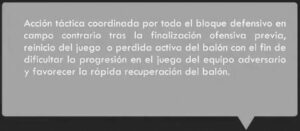
Translation
| Tactical action coordinated by the whole defensive block in the opposing field, after the previous offensive finishing, game restart or active loss of ball possession, to make progression of the opponent´s team game harder and favour a quick ball recovery. |
As we have already discussed in table 1 of module 1, it is necessary to differentiate high-press situations with set-pieces (goal kicks, throw-ins, etc.) from situations with the ball in play (high-press in the opposing field and counterpressure or CP).
In this module we will focus on the study of the most common structures used in high-press, from goal kick situations (high-press to set pieces) and from high-press situations with the ball in play (pressure jumps from medium return to the defensive shape, and pressure jumps to the goalkeeper).
Table 1: High-press situations
| Game situation | Types of high-press in the opposing field | Situations of high-press in the opposing field |
|---|---|---|
| HIGH-PRESS | 1. High-press to set pieces. | H.P. (high-press) in the goal kick. |
| 2. High-press with the ball in play. | H.P. or high-press in the opponent’s build-up of play zone. |
We won´t consider counterpressure situations as they are situations where the volitional capacity of the player who loses the ball and the nearby players is more decisive than the pattern or the organisation and tactical disposition of the players when they carry it out.
To talk about high-press structures, we need to have a clear idea of what it is. To explain the concept of structure, we must limit other concepts related to the game organisation, which we often use when talking about our team’s performance: the concept of game idea, game model and those of game structure and system.
According to David Movilla (2021), in his talk “Confronting structures”, the game idea is the set of the offensive and defensive football intentions that our team must master.
The idea of defensive play will be evidenced by the tactical intentions that you want to carry out, either:
a) intention to press (by using a high block in the opposing field).
b) intention to condition the opponent’s offensive game (by means of a block in midfield).
c) intention to resist and give in the initiative to the opponent (by means of a low block in your own field).
Versatility is given by mastering all three defensive intentions and not limiting yourself to mastering just one of them. If defensively my team only manages and masters one of these three intentions, when it is not developed correctly or is outmatched by the opponent, there will be insufficient arguments to counteract the opponent’s offensive game.
Figure 2: Game idea concept and game model
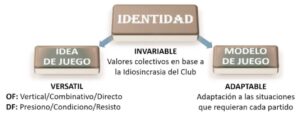
Source: Movilla, 2021, retrieved from https://bit.ly/3tQr0E3
| ESPAÑOL | INGLES |
| IDENTIDAD | IDENTITY |
| IDEA DE JUEGO | GAME IDEA |
| MODELO DE JUEGO | GAME MODEL |
| INVARIABLE | INVARIABLE |
| Valores colectivos en base a la idiosincrasia del Club | Collective values based on the idiosyncrasy of the Club |
| VERSATIL | VERSATILE |
| OF: Vertical/Combinativo/Directo | OF: Vertical/ combined /Direct |
| DF: Presiono/condiciono/resisto | DF: Press/condition/resist |
| ADAPTABLE | ADAPTABLE |
| Adaptación a las situaciones que requieran cada partido | Adaptation to situations demanded by each game |
As game model we understand how these intentions are carried out: it must be flexible and adaptable to the situations of each game, to what the opponent allows to do, to what the team believes the opponent can do. Also, to the qualities and specificities of the players of the team itself and of the opponent, to the circumstances of the field of play, weather, etc.
As game system we understand the positioning of the players on the playing field from a static point of view:
When talking about the game systems in football, reference is made to the position that the players occupy on the field before making defensive or offensive movements. However, motivated by the evolution that football has undergone, experts define it as the set of tactical principles that organise a team.
This is because originally, the vision of a game scheme refers to the distribution of the players before a play, something is merely static, but in modern football, there is not only a rigid system but also a dynamic one, due to the variations experienced before or during the game (Misamistosos, 2020, https://bit.ly/3ot02RR).
Instead, the concept of structure encompasses the positioning of players from a dynamic point of view, which is used to identify mechanisms and patterns of play.
Before it was said that teams played with a certain game system. Now, there is believed that teams have an offensive and defensive structure, which may be the same or different. The structures change according to the height of the playing field where it takes place, for example, or based on the opposing structure to be counteracted. A team can defend with one structure and attack with a different one.
Figure 3: Structure definition
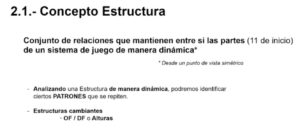
| ESPAÑOL | INGLES |
| Concepto estructura | Concept of structure |
| Conjunto de relaciones que mantienen entre sí las partes (11 de inicio) de un sistema de juego de manera dinámica* | Set of relations that parts hold among them (starts from 11) about a game system dinamically* |
| *desde un punto de vista simétrico | * from a symmetrical perspective |
| -Analizando una estructura de manera dinámica, podremos identificar ciertos PATRONES que se repiten. | -By analysing a structure dynamically, we´ll be able to identify certain repetitive PATTERNS. |
| -Estructuras cambiantes | -Changing structures |
| -OF/DF o Alturas | -OF/DF or Heights |
This module seeks to examine and learn the criteria to consider creating and / or choose the high-press structure that best suits us based on several factors to consider, such as a chosen game system, an idea of a preconceived play and a game model adapted to the needs of our team, the opponent, and the circumstances.